
Check Whether the Cat Needs Urgent Help
Before trying to help a found cat, pause and watch from several metres away so it has room to move and you can assess its condition. Look for visible signs of injury or illness, and note hazards such as moving traffic, severe weather or entrapment. Do not approach closely to inspect a frightened or injured animal. If the cat appears seriously unwell or faces immediate danger, contact a veterinary professional or appropriate animal welfare service and give the precise location.
Signs of injury or illness
Observe the cat from a safe distance, using a clear view rather than trying to touch or move it. Notice changes in its posture, movement and breathing over a few minutes.
- Bleeding that is visible from where you stand, especially blood pooling beneath the cat or continuing to drip, warrants prompt advice from a veterinary professional.
- Open wounds, exposed tissue, marked swelling or a limb held at an unusual angle can indicate significant injury; do not attempt to examine the area yourself.
- A pronounced limp, inability to put weight on one leg or dragging a limb suggests the cat may need veterinary assessment, even if no wound is visible.
- Rapid, noisy or laboured breathing, or breathing with the mouth open while resting, is a serious sign; contact a veterinary professional without delay.
- Marked weakness, collapse, inability to stand or remaining unusually motionless despite nearby activity can signal a serious problem that needs urgent professional advice.
- Disorientation, stumbling, circling or failing to respond to nearby movement may indicate illness or injury; describe exactly what you see when seeking help.
- Repeated vomiting, particularly when the cat appears weak or cannot settle, merits prompt advice from a veterinary professional or an animal welfare service.
Call a veterinary professional or appropriate animal welfare service if you see any of these signs, and explain the cat’s appearance, behaviour and location. Keep your distance while help is arranged; handling an injured or frightened cat can worsen its distress and may put you at risk.
Immediate danger
Assess the surroundings from a position where you are not exposed to the same hazard. A cat in immediate danger needs a timely response from people equipped to deal with that specific situation.
- Near a busy road, do not step into traffic or try to chase the cat; give the nearest cross street or a clear landmark when calling for help.
- During extreme heat, freezing conditions or heavy weather, note whether the cat is exposed without shelter and contact an animal welfare service promptly.
- If the cat is trapped in a drain, vehicle, building or other enclosed space, do not reach into machinery or enter an unsafe area to free it.
- Where an aggressive dog or other animal is nearby, stay behind a secure barrier and report the animals’ positions and any route the cat can use to escape.
- Check whether the hazard is active from a safe spot: moving vehicles, rising water, smoke or a closing gate can make delay especially dangerous.
- If the cat cannot move away from the threat, tell the appropriate animal welfare service what is happening now and whether emergency responders may also be needed.
Give the exact location, the type of hazard and whether the cat is moving or trapped. Follow the responding professional’s instructions rather than attempting a rescue that could put you or the cat in greater danger.
Look for Signs the Cat Has an Owner
When you have found a stray cat, visible identification can offer useful clues without requiring you to handle it. Check what you can see from a safe distance, such as a collar, a tag, or readable contact details. Treat any information as a lead rather than a guarantee that the cat’s current situation is known. A missing collar or an ordinary-looking coat cannot establish whether the cat has a home.
Collar and visible identification
Look over the cat from a distance and note any collar, tag, or marking that is clearly visible. A phone camera’s zoom can help you read a tag without reaching for the cat or trying to turn its collar.
| What you can see | Information it may provide | Limits of the observation |
|---|---|---|
| Collar with a buckle or quick-release clasp | Shows that someone has fitted a collar; a quick-release clasp is designed to open if the collar catches. | A collar alone does not identify a keeper. It may be loose, partly hidden by fur, or no longer in use. |
| Hanging or flat identification tag | A tag may display the cat’s name, a keeper’s telephone number, or a short message such as “I’m lost.” | Small print may be unreadable at a distance, and an old number or worn engraving may not reach the current keeper. |
| QR-code or contact-detail tag | A readable code or printed number may lead to contact details or a pet profile. | A code can be damaged or require a phone to scan; do not assume it is current if the visible details are incomplete. |
Do not tug at a collar or try to inspect its underside while the cat is wearing it. Record only details you can read clearly; a visible name or number is more useful than guessing from a partly obscured tag.
Appearance is not proof
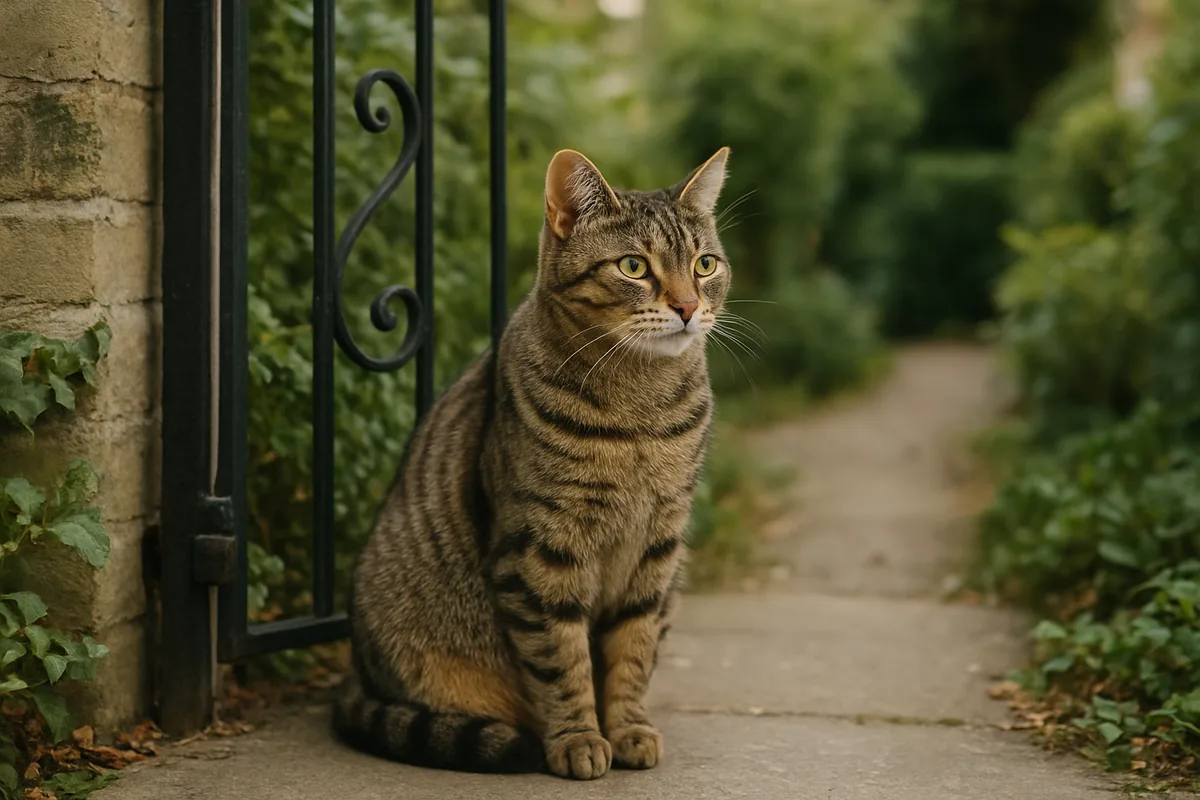
A healthy, well-groomed cat may still be lost. A clean coat, bright eyes, or a relaxed manner can describe the cat’s condition at that moment, but none confirms that it knows its way home or that its keeper is nearby. Cats with outdoor access may also look settled in a place where they do not live. An uncollared cat is not necessarily abandoned. Collars can come off, and some keepers do not use them; fur length, coat pattern, body size, and apparent age also cannot establish whether a cat is owned. A cat sitting near houses, shops, or a feeding spot may be familiar with the area without belonging to the nearest household. Use appearance and location only as observations, not a verdict. Note specific details such as coat colour, a distinctive marking, or the street where the cat was seen, and keep them separate from assumptions about its status. Even a confident, sociable cat may have become separated from its keeper, while a wary cat may simply be unfamiliar with people. Visible identification can offer a clearer lead than appearance, but its details still need to be confirmed.
Take Practical Steps to Find the Keeper
A few respectful enquiries can help establish whether someone nearby knows the cat or can share useful observations. Keep messages brief, factual and limited to information that helps people recognise the situation. Choose ways to communicate that do not expose anyone’s address, phone number or other private details. If arranging a microchip scan, ask the veterinary practice or animal welfare service how to proceed before moving the cat.
Ask nearby residents
Start with people who live or work close to the place where you saw the cat. A calm, specific question is more useful than a broad public appeal, and gives residents a chance to share what they know without pressure.
- Ask nearby residents politely whether they recognise the cat, and make clear you are seeking information rather than asking anyone to take responsibility.
- Give a short description, such as the cat’s coat colour and approximate size, so people can connect your question with a familiar animal.
- State when and where you saw the cat, using a nearby street or public landmark rather than someone’s home address.
- Invite people to share sightings through a private reply or a moderated neighbourhood group, instead of posting personal phone numbers publicly.
- If you use a noticeboard or online post, choose an image and wording that do not reveal house numbers, private locations or residents’ identities.
Ask at a suitable time and accept that residents may not know the cat or be available to respond. Keep the enquiry focused on recognition and observations; do not enter a home or enclosed property, and do not remove the cat unless there is a clear welfare reason.
Ask about a microchip
A veterinary practice or animal welfare service may be able to scan the cat with a handheld microchip reader. Call first to ask whether scanning is available, whether an appointment is needed and what they recommend for this particular cat. Availability and arrangements can vary, so confirm before setting off. A scan can detect a chip number; the number can then be checked against a registration database by someone with appropriate access. If the registration has usable, current contact details, the keeper may be contacted. The scan does not itself confirm who currently cares for the cat, and a chip record may be missing or out of date. A failed reading does not establish that the cat has no keeper: a chip may not be present or may not be detected. Explain on the call whether the cat can be approached and handled comfortably. If it can be moved without distress or risk, ask how to transport it securely; a closed, suitable cat carrier is preferable to carrying it loose. Do not chase or force a frightened cat into a carrier just to obtain a scan. Ask the service what safe arrangement is available if you cannot handle or transport the cat. A scan is a practical way to check for a registered contact, but the service may need time to process the number and reach someone. Ask what information they can share with you; a keeper’s private address or phone number should not be posted publicly.
When You Cannot Identify the Cat
If you have found a stray cat and cannot identify a keeper, an appropriate local service can advise you on the next step. The right contact depends on the cat’s condition, its location and whether it can remain safe while you seek guidance. Local animal welfare services can explain how found cats are handled in your area, while a veterinary professional can advise on urgent health concerns. Share clear, factual details and ask what action they recommend before making arrangements. A brief written record can help you give consistent information if you need to call again.
Contact an appropriate local service
Start by calling an animal welfare service that handles found animals locally, or a veterinary practice for advice about a health concern. If you are unsure which service is responsible, explain the area where you found the cat and ask who should take the report. Local procedures and available services differ, so confirm the correct contact rather than assuming every practice can take in a found cat.
Give the exact location, the time you saw the cat, a concise description and a factual account of its visible condition and behaviour. Say whether it is still there, whether it can be approached safely, and whether traffic or another immediate hazard is present. These details help the person advising you judge whether the next step is an assessment, a response from an animal welfare service or further monitoring.
Ask what to do while help is arranged, whether the cat should remain where it is, and whether the service needs any further information. Check opening hours and how to reach an out-of-hours service if the first contact is unavailable. Do not assume that a shelter or veterinary practice can accept the cat without prior agreement; follow the instructions given by the service responsible for your area.
If the cat is injured or in immediate danger, contact an appropriate veterinary professional or official animal welfare service promptly. State the location first, describe the urgent concern plainly and say whether you can stay nearby without putting yourself at risk. Do not delay that call to gather a complete history or create a detailed record.
Keep a simple record
A short, factual note can make follow-up calls clearer, especially if the cat moves or another person contacts the service. Record what you directly observed rather than guessing its history or ownership.
- Write the date and approximate time of each sighting, including whether you saw the cat once or at several different times.
- Note the precise location, such as the street, nearest junction or a clear public landmark, so a responder can find the area.
- Describe visible identifying features, including coat colour and pattern, approximate size, distinctive markings and any noticeable physical differences.
- Record its visible condition and behaviour in plain terms, such as whether it was walking, sitting, hiding or vocalising when observed.
- State whether it appeared to be in immediate danger, noting an observable hazard such as a busy road or an unsafe enclosed area.
If you take a photograph from a safe distance, note when it was taken and keep it with the same record. Share observations and images only with the service handling the report, and update the notes if the cat’s location or condition changes.
Common Mistakes to Avoid
A single sighting gives only a snapshot of a cat’s circumstances, not a reliable answer about whether it has a keeper. A cat outdoors may be resting, travelling through its usual area or temporarily away from home. Sudden changes, such as carrying it elsewhere or offering food, can affect its routine and make it harder for its keeper to find. Match any action to what you can observe: leave a calm cat undisturbed when the setting is safe, and seek appropriate help if its condition or surroundings make inaction unsafe.
Assuming every outdoor cat is stray
Seeing a cat outside does not establish that it is lost. Cats may spend time in gardens, on footpaths or near shops while still returning to a home nearby; one encounter cannot show whether the animal is on its normal route. A cat that appears relaxed in a familiar-looking area may still need help, while a cat alone in an unfamiliar place may have a keeper. Treat location as context, not proof.
Appearance is also an unreliable test. A clean coat or confident manner does not confirm that a cat is cared for, and a thin or untidy coat does not by itself prove abandonment. Weather, recent travel and an individual cat’s habits can affect what you see. Avoid deciding from one visual detail that the cat belongs to nobody or needs to be taken away.
Use proportionate checks instead of making that assumption. Observe from a distance and consider whether the cat is moving calmly through the area or repeatedly returning to one spot. If it seems settled and the surroundings are safe, give it room while you take reasonable steps to check for a keeper. If there is a clear, immediate concern, respond to that circumstance rather than relying on guesses about ownership. This cautious approach helps prevent a found stray cat from being separated unnecessarily from someone who is looking for it.
Feeding or moving the cat without considering its needs
Food can seem like a quick way to help, but feeding a cat you have just found may change its behaviour. It might stay in one place expecting more, attract other animals, or eat something unsuitable for its needs. If the cat is calm and the location is safe, avoid using food to lure it closer; leave the area accessible and allow it to move away. If water or food is appropriate in the circumstances, place it in a stable dish where the cat can reach it without being crowded, and do not force it to eat.
Moving the cat farther away can be especially disruptive. A keeper may be searching around the place where the cat was last seen, and relocating it to another street, a car or your home can make that search harder. Do not pick up or transport a cat simply because it is outdoors. If traffic or another immediate hazard makes the exact spot unsafe, move it only as far as needed to reach a nearby safer place, and only if you can do so without putting yourself or the cat at risk. Otherwise, seek suitable local assistance rather than carrying it away.
Approaching too quickly can also turn a manageable encounter into a chase. Walk slowly, keep your body angled rather than facing the cat head-on, speak quietly and leave it a clear route to retreat. Do not corner it, reach suddenly or try to lift a frightened cat by hand. If it remains relaxed and needs to be transported, use a secure humane cat carrier rather than holding it loose in a vehicle. Keep it separate from household pets while arrangements are made. When there is no immediate danger and the cat appears settled, giving it space is usually less disruptive than feeding, handling or relocating it.